See the investment behind the community.
Build your mobile home park analysis around site income, operating expenses, and acquisition financing. Turn your assumptions into a clearer investment decision.
Free account creation. A paid plan is required to analyze your own deals.
 DealWorthItAnimated sample
Cedar Grove · 40 developed sites
At acquisition: 28 tenant-owned + 8 park-owned occupied homes · 4 vacancies
● T · Tenant-owned● P · Park-owned┄ Vacant
- Tenant-owned homes
- 28 occupied · 2 vacant pads
- Park-owned homes
- 8 occupied · 2 vacant homes
- Developed sites
- 40 · 90% occupied
- Undeveloped potential
- 6 pads · not operating inventory
Illustrative sample; constant rents, no turnover or growth. Park-owned lot rent stays $450/month. Infill uses linear monthly delivery; added expenses phase with delivery. Capital budget funded at closing. Closing costs, reserves, and income taxes excluded. Projections are not guaranteed.
Start with the sites. Understand the cash flow.
Mobile home park analysis starts with the sites that generate income. Separate occupied sites from vacant sites, review the operating costs of the community, and test whether the income supports your purchase price and financing.
A home and its site are different inputs.
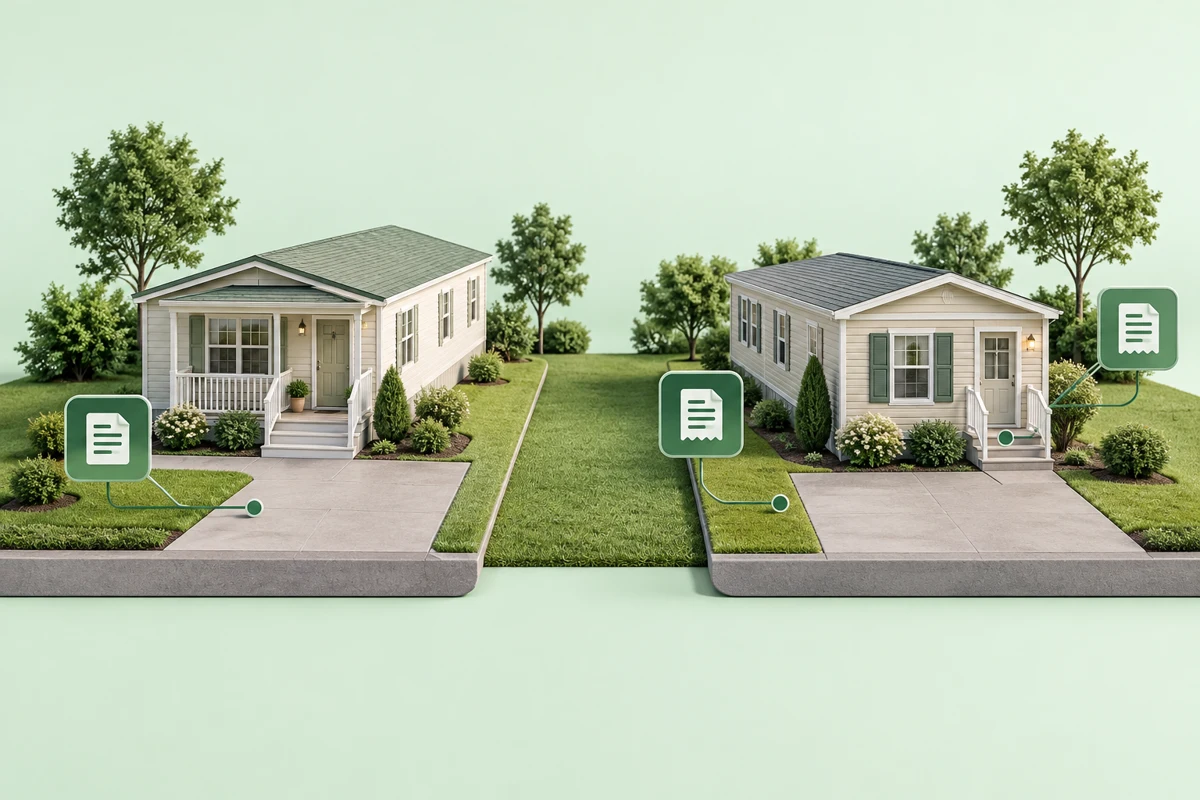
Keep the land lease separate from the home. That distinction helps you see which income belongs to the site and which costs come with owning the structure.
Lot rent
The resident owns the home. Model the rent paid for its site.
Lot + home-only rent
Separate the lot portion from the home portion, then review the costs of ownership.
What you put in, and what comes out
Enter your assumptions. Review the results. Keep every input visible and editable.
Key inputs
- Purchase price and acquisition assumptions
- Tenant-owned and park-owned home inventory, occupancy, and lot rent
- Separate lot and home-only rent for park-owned homes
- Infill schedule, home make-ready, and infrastructure budgets
- Other income supported by your records
- Operating expenses and utility costs
- Acquisition financing: loan amount, rate, and amortization
Analysis outputs
- Annual operating income and expenses
- Net operating income (NOI)
- Cap rate at your purchase price
- Debt service and coverage
- Projected cash flow after financing
What the mobile home parks workflow does
 A model built around the asset
Start with the sites. Understand the cash flow.
Explore the decisions behind your analysis, from the first assumption to the final report.
01Start with site income+
Build a base case from the community’s sites and current rents. Keep occupied and vacant sites distinct so an infill opportunity does not become income before it exists.
02Keep lot and home income separate+
Tenant-owned homes generate lot rent. Park-owned homes have separate lot and home-only rent inputs. Vacant developed pads and undeveloped potential pads stay distinct from occupied inventory.
03Plan infill before counting its income+
Set the first and last months of leasing, identify which vacant pads or homes you plan to fill, and budget for installation and infrastructure. The model phases income with delivery rather than counting it all on day one.
04Give operating costs their own review+
Review taxes, insurance, management, utilities, and repairs. Separate recurring operating costs from capital projects such as road or utility replacements.
05Test the acquisition financing+
Enter your financing assumptions and review debt service alongside NOI. A lower purchase price or a different loan structure can change cash flow materially.
06Compare the investment case+
Review the relationship between income, costs, and financing before deciding on an offer. Document the evidence behind each assumption.
From occupied sites to an investment summary.
A 42-second walkthrough of the illustrative community. Pause at any stage to review the assumptions.
- Inventory: 28 occupied tenant-owned homes, 8 occupied park-owned homes, 2 vacant pads, and 2 vacant park-owned homes. Six undeveloped pads stay outside operating inventory.
- Rents: $500 tenant-owned lot rent. Park-owned rent is $450 for the lot plus $350 for the home, per month.
- Infill: Lease the 4 vacancies in months 3–6. Income and $4,800 of added annual operating costs phase with delivery.
- Expenses: $90,000 base annual operating costs; $93,400 in year 1 with phased infill.
- Financing: $900,000 loan at 6.5% over 30 years. $400,000 cash equity covers the purchase balance and $100,000 capital budget.
- Returns: $180,700 year-one NOI and approximately $112,437 cash flow, including $7,200 other income.
- Report: Review the ownership mix, phased income, and financial results together.
Silent sample video. Constant rents; no turnover or growth. Closing costs, reserves, and income taxes excluded. Infill and infrastructure budgets are funded at closing.
The analysis is one stage of five
Carry the same property from discovery through research, analysis, comparison, and reporting.
Find
Discover on-market and off-market opportunities.
Research
Review ownership, debt, tax, property, comparable, and market data.
Analyze
Underwrite deals using asset-specific financial models.
Compare
Test scenarios and assumptions side-by-side.
Present
Create clear reports for investment decisions, partners, and teams.
Other investment types: Multifamily · Self-Storage · Single Family · New Construction
Mobile Home Parks analysis, answered
Can DealWorthIt analyze a mobile home park?
Yes. DealWorthIt includes a dedicated mobile home park analysis workspace for site income, operating expenses, and acquisition financing.
Start with your community records and review the assumptions before using the results.
How is a park different from an apartment investment?
A park’s site rents and home ownership mix need their own review. Tenant-owned homes, park-owned homes, vacant pads, and utility responsibilities can create different income and cost assumptions.
Review those distinctions rather than treating every site as an identical apartment.
What records should I gather?
Start with site and occupancy records, rent collections, operating statements, utility bills, and financing terms. Separately inspect infrastructure, zoning, leases, and home titles with the appropriate professionals.
Which plans include mobile home park analysis?
Silver, Gold, and Diamond include the core mobile home park workflow. Gold and Diamond add advanced analysis, document import, and side-by-side scenario comparison.
Team collaboration requires Diamond.
Is the animated example a live deal?
No. The example uses illustrative assumptions to explain how site income, expenses, and debt service connect.
It is not a valuation or a forecast for a specific community.
Further reading
Practical guides for your next mobile home parks analysis.
Run your next mobile home parks deal through it
Research the opportunity, test your assumptions, and share a clear investment report.