
Mobile Home Park Investing in 2026: Benefits, Risks and Due Diligence
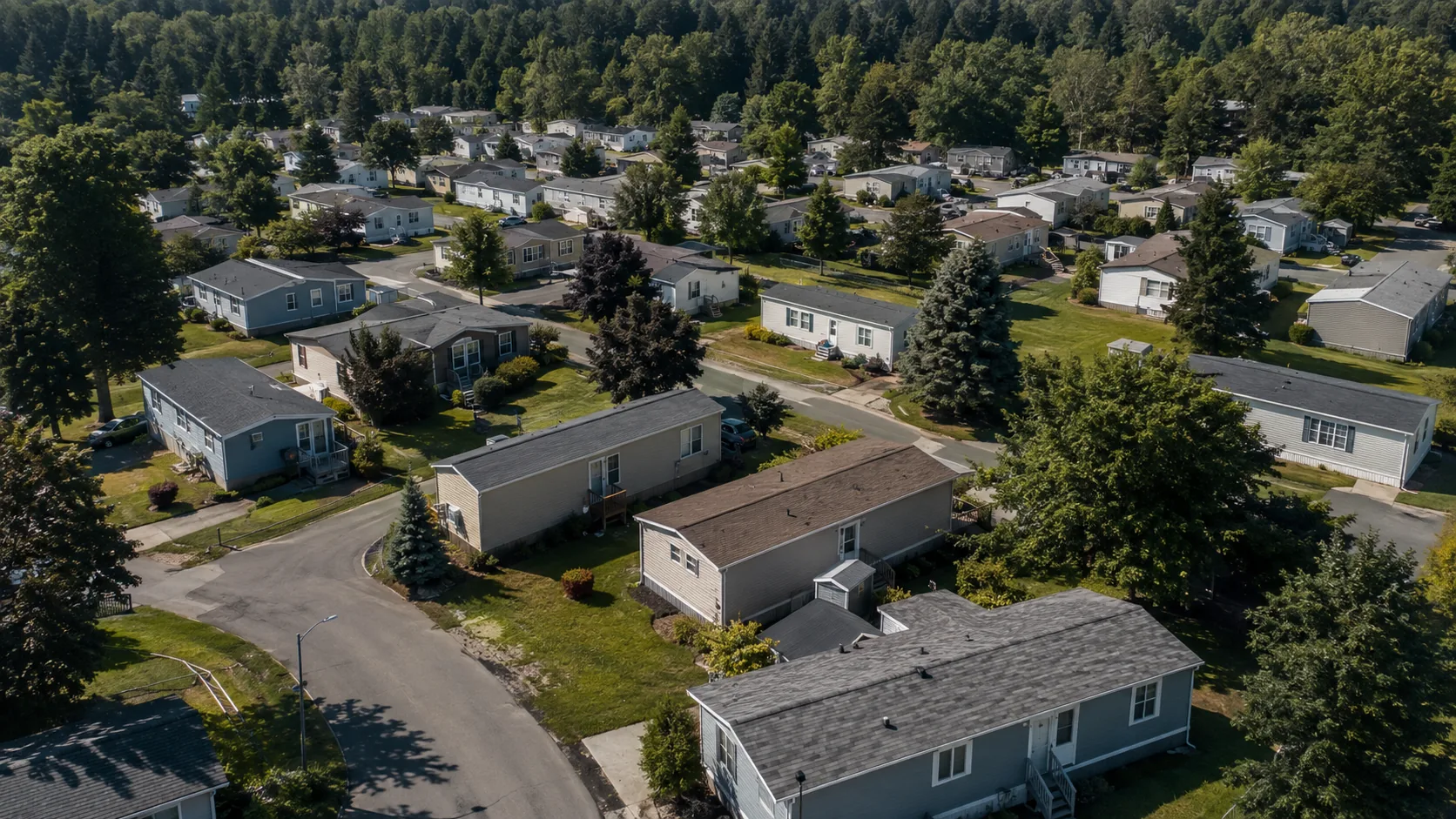
The short answer
Manufactured-housing communities can offer durable demand and real operational upside, but they carry specialized legal, infrastructure, financing, tenant, reputational and execution risks that do not appear in an apartment underwriting model. A low price per lot and a shortage of new supply do not by themselves make a good investment.
This asset class rewards operators who can run a small water utility, read a state landlord-tenant statute, and tell the difference between a lot that is vacant and a lot that can actually be filled. It punishes buyers who multiply occupied pads by lot rent and call the result net operating income.
Three corrections to the way this subject is usually written about, all of which this guide sources below:
- The terminology is not interchangeable. A mobile home was built before the federal HUD Code took effect on June 15, 1976. A manufactured home was built to that code afterwards. The property you buy is a manufactured-housing community. These distinctions decide financing, insurance, titling and in some states whether a home can legally be replaced at all.
- Financing is the hard part, not the easy part. Citing its analysis of 2024 federal mortgage data, FHFA reports that manufactured-home borrowers, "particularly those seeking personal property (chattel) loans", face a 65.6% denial rate against 8.8% for site-built homes, at an average 9.24% versus 6.63%. Those are different loan products and different applicant pools, not a like-for-like comparison — but the gap is large enough to constrain who can buy homes in your community, which constrains your infill plan.
- Lot rent is regulated in more places than most buyers expect, and the rules differ by state. Florida requires 90 days' notice of any increase. Delaware ties increases above a CPI-linked formula to a justification standard, a required meeting and nonbinding arbitration. There is no national rule, and a pro forma built on the assumption that your next state resembles your last one is not an underwriting; it is a guess.
If you are new to the asset class, the honest framing is this: manufactured-housing communities are an operating business attached to buried infrastructure, wrapped in a state-specific legal regime, housing residents who own their homes but not the ground beneath them. That last fact is what makes the asset stable and what makes it politically and ethically fraught. Both are true at once.
Mobile home, manufactured home, or something else entirely
The popular search phrase is "mobile home park". The legal vocabulary is more precise, and the precision matters commercially. Here is what each term actually denotes.
| Term | What it means | Why it matters to a buyer |
|---|---|---|
| Mobile home | A factory-built home produced before June 15, 1976, the date the federal construction standards took effect. | A pre-code home carries no HUD certification label, and Fannie Mae's Selling Guide requires a label or data plate — or an IBTS verification letter — for a manufactured home to be eligible for sale to Fannie Mae (B2-3-02). FHFA, explaining why pre-code homes are excluded from the Duty to Serve definition of a manufactured home, states it "does not believe that appropriate methodologies exist for assuring the structural integrity of pre-HUD Code homes" (91 FR 37848). A community with many of them has a resale and replacement problem; confirm insurability separately, since that is set by the carrier and not by federal rule. |
| Manufactured home | A home built to the HUD Code — 24 CFR Part 3280 — on or after June 15, 1976. 24 CFR 3280.2 defines it as transportable, 8 body feet or more wide or 40 body feet or more long, or 320 or more square feet when erected, built on a permanent chassis. | This is the only category the federal manufactured-housing programs recognize. Every transportable section carries a red HUD certification label; missing labels are a due-diligence finding. |
| Modular home | A factory-built home constructed to state or local building codes, not the HUD Code. | Often built in the same factories as manufactured homes, but a different regulatory animal. Do not assume a modular unit qualifies for a manufactured-housing loan program. |
| Recreational vehicle | Excluded from the federal definition of a manufactured home: "The term does not include any self-propelled recreational vehicle." | An RV park is a different asset with different zoning, different tenancy law and often different licensing. Communities that mix the two need both analyzed separately. |
| Manufactured-housing community | At 12 CFR 1282.1, "a tract of land under unified ownership and developed for the purposes of providing individual rental spaces for the placement of manufactured homes for residential purposes within its boundaries." | This is the thing being bought and sold. Fannie Mae's guide adds the operational reality: lots "together with amenities, utility services, landscaping, roads, and other infrastructure." |
| Land-lease community | The common commercial description of the same structure: the operator owns the land and infrastructure, residents own their homes and lease the lot. | Describes the economics rather than the statute. Useful shorthand, not a legal classification. |
| Resident-owned community (ROC) | A community whose residents have collectively purchased it, usually through a cooperative. | Relevant to a buyer as competition, as an exit route, and because several states give residents a statutory opportunity to purchase before an outside sale closes. |
| Tenant-owned home on a leased lot | The resident owns the structure; the operator leases them the pad. | The operator's revenue is lot rent. The operator does not maintain the home. |
| Park-owned home | The operator owns the structure and rents home and lot together. | Higher revenue per lot, but the operator now has a residential rental business with repairs, turnover, appliances and — depending on the state — different tenancy law. |
A note on "mobile home park" as a phrase: it is not obsolete in law. The Fair Housing Act regulations on housing for older persons list "a mobile home park" and "a manufactured housing community" as two separate examples of a housing facility or community. But it is not a construction classification, and using it as one — in a lease, an offering memorandum, or an insurance application — introduces ambiguity where you least want it.
Terminology, title treatment, zoning, landlord-tenant rules, rent regulation, closure requirements and relocation protections all vary by state and locality. Nothing in this guide is a substitute for reading the statute that governs the specific community you are buying.
How manufactured-housing communities make money
Revenue in a land-lease community comes from a small number of lines, and the mix tells you most of what you need to know about how much work the asset will be.
- Lot rent from tenant-owned homes. The core line. The operator provides the pad, the roads, the utility infrastructure and the common areas; the resident provides and maintains the home.
- Home-and-lot rent from park-owned homes. Higher per unit, but it converts part of the business into residential property management.
- Utility reimbursement. Where permitted, water, sewer and sometimes trash are billed back to residents. The rules on how, and whether you may mark up, are set by state law and sometimes by the public utility commission.
- Other income. Storage, extra parking, laundry, pet fees, late fees. Small in aggregate and frequently overstated in a seller's pro forma.
- Home sales or financing. Selling or financing homes to incoming residents. This turns the operator into a retailer or a lender, with the consumer-protection obligations that follow.
Against that, the operator carries the infrastructure. In an apartment building the landlord maintains the building. In a land-lease community the landlord maintains what is under the ground: water lines, sewer lines or septic fields, electrical distribution, storm drainage and roads. That is the trade. Lower per-lot revenue than an apartment unit, lower turnover cost, and a capital burden that is largely invisible until it fails.
Ownership and operating models
No model is universally superior. Each trades revenue against operating burden, legal exposure and financeability. The right question is not "which is best" but "which am I equipped to run, and does the price reflect it".
| Model | Revenue effect | Operating and capital effect | Legal, insurance and financing effect |
|---|---|---|---|
| Tenant-owned home, leased lot | Lowest revenue per lot, and the least variable — the operator collects one charge and owns no structure. | Least repair and turnover exposure — the operator does not own the structure. Capital spend concentrates in shared infrastructure. | The structure agency programs are written around. Governed by manufactured-housing tenancy law where the state has a distinct statute. |
| Park-owned home, home and lot leased | Highest revenue per lot. | Full residential maintenance: roofs, HVAC, appliances, turnover, make-ready. Turnover cost per event is high because the asset is a house. | May be treated as ordinary residential tenancy rather than lot tenancy. Lender programs cap this share explicitly: Freddie Mac's Optigo MHC term sheet allows up to 25% of homes to be rentals and caps homes owned by a borrower affiliate or third-party investor at 25% in aggregate (term sheet). Confirm the cap in the program you are actually being quoted. |
| Rent-to-own or contract for deed | Revenue between the two, plus a sale. | Ambiguous maintenance responsibility during the contract term is a frequent source of dispute. | Seller financing a home to a resident can bring the operator within mortgage-origination and consumer-protection rules, which is a body of law the other models do not touch. It can also disqualify the loan: Freddie Mac's Optigo MHC term sheet states that "retail sales or financing by borrowing entity of any manufactured homes is not allowed" (term sheet). Take advice before structuring these. |
| Resident-owned cooperative (ROC) | Not an investment vehicle for an outside buyer. | Residents govern collectively; professional management is often retained. | Relevant as competition and as a statutory exit route in states with purchase-opportunity laws. |
| Mixed community | Blend of the above. | Two operating disciplines under one roof. Frequently the hardest to staff well. | Requires both legal regimes to be understood. Lender treatment depends on the park-owned share. |
| Age-restricted (55+) | Can support different rents and lower turnover in the right submarket. | Amenity and accessibility expectations are typically higher. | Compliance obligation. To claim the Fair Housing Act exemption, at least 80% of occupied units must be occupied by at least one person 55 or older, plus intent and verification requirements. Falling out of compliance means losing the right to restrict families with children. |
| All-ages | Widest tenant pool. | Different amenity mix; playgrounds, traffic calming, school proximity matter. | No age-restriction compliance burden, and no exposure to losing it. |
The park-owned share is the input that moves the most other inputs at once: revenue, repairs, turnover, capital expenditure, staffing, collections, legal exposure, insurance and financing eligibility all change with it, and lender programs cap it directly. A community that is 90% tenant-owned and one that is 40% park-owned are different businesses at the same address, so establish the share before you compare two communities on price per lot.
Why investors look at this asset class
The arguments in favor are real. They are also narrower than the marketing suggests, so each one below is stated with its actual limit.
The affordability position is genuine and federally documented
The Consumer Financial Protection Bureau describes manufactured housing as accounting for "about six percent of occupied housing stock in the U.S." and as "the largest source of unsubsidized affordable housing in the country" (CFPB, May 2021). That is a structural statement about the housing stock, sourced to a federal regulator, and it is the best-evidenced argument for the asset class.
Its limit: a documented shortage of affordable housing tells you nothing about whether a particular community at a particular price will produce a return. Scarcity is not a valuation.
The cost gap between a manufactured home and a site-built home is large
The Census Bureau's Manufactured Housing Survey puts the average sales price of a new manufactured home at $134,800 in February 2026 — $89,100 for a single-section home and $163,100 for a double-section (Census MHS). That is the price of the home as reported by the dealer; Census publishes no land component with it, and site preparation, delivery and installation are separate costs. That distinction is the point of a land-lease community — the resident buys the house without buying the dirt — but do not read the figure as an all-in cost of housing a family.
Its limit: a home priced without land is also why financing is hard. A home without land is collateral that can be moved, and lenders price that accordingly — see the financing section.
New supply is genuinely constrained in most jurisdictions
Local zoning decides where a manufactured-housing community may be sited, and in many jurisdictions no land is zoned for a new one. No federal dataset counts how many jurisdictions permit new community development, so this guide publishes no national figure — but the constraint is verifiable one jurisdiction at a time, and where it holds it does support existing communities.
Its limit, and this one is important: the same restrictive zoning that keeps a competitor from building next door is what makes many existing communities legal non-conforming. A non-conforming community may not be rebuildable at its current density after a fire, flood or tornado. The scarcity that protects your revenue can also mean your insurance proceeds cannot restore your asset. Verify the zoning status and the rebuild rights before you treat scarcity as a moat.
Shipments have been broadly stable, not booming
Census recorded 102,700 new manufactured homes shipped in 2025, against 103,300 in 2024, 89,200 in 2023, 112,900 in 2022 and 105,800 in 2021. Through May 2026, 41,400 units have shipped, with May preliminary at a seasonally adjusted annual rate of 100,000.
What this is not: a shipment is a factory-to-retailer movement. It is not a home installed, not a home occupied, not a lot filled, and not a transaction in a community. No federal series converts shipments into net community occupancy, and anyone who quotes shipments as evidence of demand for your specific lots is overreaching.
The risks marketing articles tend to minimize
Each of the following is a claim this guide explicitly rejects, with the reason.
| The claim | Why it does not hold |
|---|---|
| "Recession-proof" or "recession-resistant" | No asset class is. Residents in this segment have lower median incomes than site-built homeowners, which cuts both ways: demand for affordable housing may hold up, but collections, bad debt and the ability to absorb a rent increase weaken in a downturn precisely when you need them not to. |
| "Guaranteed demand" | Demand for affordable housing in general is not demand for your community. A community with failing water, a bad reputation, or a shrinking local employer can sit half empty in a housing-short metro. |
| "Passive income" and "low maintenance" | You are responsible for roads, water distribution, sewage collection, storm drainage and electrical infrastructure. If the community has its own well or septic, you are operating regulated utilities. That is not passive. |
| "Tenants never move" | Relocating a home is difficult and expensive — Freddie Mac says so plainly in its Duty to Serve work. But homes are abandoned, evicted, condemned and removed. Low turnover is not zero turnover, and an abandoned home is a liability with a title problem, not a vacant unit. |
| "No new supply, so no competition" | Your competition is every other affordable housing option in the submarket: older apartments, small rentals, other communities, and homeownership. It is also the possibility that residents organize and buy the community themselves under a state purchase-opportunity law. |
| "Easy financing" | For the community, financing depends on occupancy, park-owned share, utility systems, sponsor experience and market. For the homes your residents need to buy, the federal data on denial rates is stark. See the financing section. |
| "Automatic appreciation" | Value is a function of net operating income and the exit cap rate. Both can move against you, and the buyer pool for a community with private utilities and deferred capital is thin. |
| "Investors can freely raise lot rent" | Directly false in a number of states. Delaware requires 90 to 120 days' notice and subjects increases above a CPI-linked formula to a justification standard, a required meeting and nonbinding arbitration with a route to Superior Court. Florida requires 90 days' notice and a good-faith disclosure of the factors justifying the increase, with a route to mediation. Some localities add rent stabilization on top. |
| "Utility systems are inexpensive to maintain" | A private water system serving the community is a regulated public water system with sampling, monitoring, reporting and notification duties. A septic system serving 20 or more people per day is a Class V injection well. These are compliance programs with ongoing cost, not line items. |
| "Manufactured homes always depreciate" / "always appreciate" | Both are wrong as universals. Value depends on the home, the condition, the land tenure, the local market and whether the home is titled as personal or real property. A home on owned land titled as real property behaves differently from the same home on a leased pad. |
| "Communities consistently outperform apartments" | This guide publishes no comparative return claim in either direction, because no cap-rate survey with a published methodology, stated as-of date and free primary source could be verified for this asset class. Price a specific community against recent sales of comparable communities in its region. |
| "Affordable housing means a safe investment" | The affordability of the housing is a fact about residents' budgets. It is not a fact about your basis, your capital plan or your exit. |
The risk that deserves separate treatment
Residents in a land-lease community own a structure that is expensive and often impractical to move, sited on land they do not control. That asymmetry is the defining feature of the asset class. It is why the sector attracts legislative attention, why several states have enacted purchase-opportunity and rent-justification statutes, and why acquisitions here draw local press coverage that an apartment purchase would not.
Treat that asymmetry as a risk to be managed, not an advantage to be harvested. A buyer whose model depends on large rent increases against residents who cannot leave is underwriting political, legal and reputational exposure alongside the cash flow — and in several states, underwriting a rent increase the law will not permit.
Screening markets and submarkets
Before property-level work, establish whether the submarket supports the business. This guide deliberately does not publish a list of "best states"; the previous version of this article did, without evidence, and the list was removed. Apply the screen yourself:
- Competing communities. How many, what condition, what occupancy. Drive them.
- Lot-rent comparisons. Actual asking lot rents at comparable communities, collected directly, not from a national average.
- Home-price comparisons. What a used home in the community sells for locally. This sets the ceiling on your infill economics.
- Infill demand. Is there a waiting list anywhere in the submarket, or are competitors also sitting on vacant lots?
- Local placement restrictions. Many jurisdictions restrict where a manufactured home may be sited, and some impose age limits on homes being moved in. A rule barring homes older than ten years can make your vacant lots unfillable at any price.
- Employment and population trends. Federal sources: BLS state and metro employment, Census population estimates.
- Tenant income and affordability. Local median household income against your lot rent plus a home payment plus utilities. If the total exceeds what the submarket earns, your rent roll is a hypothesis.
- Alternative housing costs. What an older two-bedroom apartment rents for locally. That is your true competition.
- New supply. Rare for communities, but check apartment permitting: Census Building Permits Survey.
- Climate and hazard exposure. Flood zone via the FEMA Flood Map Service Center; wind and wildfire exposure; and the insurance market's current appetite in that state. Manufactured homes are more wind-vulnerable than site-built construction, and insurance availability has become a material underwriting variable in several states.
Property-level due diligence
Underwriting a community requires more than multiplying lot rent by occupied pads. The following is the minimum.
Property and title
- Legal parcel boundaries — surveyed, not assumed. Communities that grew organically frequently have homes sited across parcel lines.
- Easements of every kind, and whether any burden the expansion land.
- Road ownership. Public, private, or an undocumented arrangement with the municipality. Private roads are a capital line forever.
- Utility easements, including any granted to a third-party utility across the community.
- Title to park-owned homes. Separate from the land title. Get the certificates of title, not a schedule.
- Home titles versus real-property deeds. Which homes are titled as personal property and which have been converted to real property. The distinction changes taxation, financing and what transfers at closing.
- Abandoned homes. Each is a title problem and a removal cost, not an asset. Confirm the state's abandonment procedure and how long it takes.
- Encroachments — sheds, decks, additions, fences crossing lot lines or setbacks.
- Expansion land — is it entitled, is it served by utilities, and is the entitlement transferable?
- Zoning and legal-conforming status. Conforming, legal non-conforming, or illegal. If non-conforming, obtain in writing what may be rebuilt after a casualty and at what density.
Operations
Ask for these as separate numbers. A seller who reports only "occupancy" is reporting the number that flatters them most.
- Total developed lots versus occupied lots versus infill-ready lots. A lot with no pad, no utility pedestal and no road frontage is not inventory.
- Physical occupancy (lots with a home) versus economic occupancy (lots actually paying). The gap is where the story is.
- Park-owned homes, vacant park-owned homes, and home inventory held for sale.
- Delinquency, concessions and bad debt — trailing twelve months, by month.
- Employee or manager units, and whether they are recorded as occupied.
- Utility reimbursements — billed, collected, and the basis on which they are calculated.
- Other income, itemized, with the recurring portion separated from the one-off.
- Turnover and abandonment counts for the trailing period.
Infrastructure and environmental due diligence
Private utility systems can create capital, regulatory, testing and operational exposure that appears nowhere in a rent roll, which is why this section is longer than it looks like it should be.
The two federal thresholds every buyer should know
A system that provides water for human consumption "to at least 15 service connections or serves an average of at least 25 people for at least 60 days a year" is a public water system under EPA rules (EPA). Fifteen connections is fifteen occupied lots, and 25 residents is roughly a dozen, so any community above about a dozen occupied lots on its own well will meet that threshold. A community whose residents live there year-round will generally also meet EPA's definition of a community water system — "a public water system that supplies water to the same population year-round" — which is the most heavily regulated category, with Safe Drinking Water Act sampling, monitoring, reporting and public-notification duties. The practical consequence is that a private well is not a building system to be maintained; it is a regulated utility to be operated, staffed and reported on.
A septic system that "receives solely sanitary waste either from multiple dwellings … and the system has the capacity to serve 20 or more persons per day" is a large capacity septic system, classified as a Class V injection well under the Underground Injection Control program (EPA). The owner must submit inventory information to the permitting authority, and the discharge must not endanger underground sources of drinking water. States may impose stricter requirements.
The physical inspection list
- Water: public connection or private well. If private — yield, water quality history, treatment equipment, storage, pressure, the full sampling record and any violations or consent orders.
- Sewer: public connection, private collection into a public plant, package treatment plant, community septic, or individual septic per lot. Each is a different capital and compliance profile.
- Septic systems and drain fields: age, condition, soil percolation, replacement area availability. A drain field with nowhere to go when it fails is an existential problem, not a repair.
- Wells: age, casing condition, depth, backup capacity, and what happens if the primary fails on a holiday weekend.
- Lift stations: count, age, condition, redundancy, alarm and telemetry, and generator backup.
- Electrical: who owns distribution to the pedestal, pedestal age and amperage, whether service is adequate for modern homes and appliances.
- Gas: owned distribution, propane tanks, or individual service. Owned gas distribution is a regulated activity in many states.
- Roads: surface type, base condition, drainage, and whether emergency vehicles can turn.
- Drainage and stormwater: any permit, any detention structure, and any history of standing water.
- Trees: mature trees over homes are an insurance and casualty exposure specific to this asset class.
- Fire access: hydrant locations and flow, access width, and the fire marshal's current view of the community.
- Metering and internet: whether utilities are individually metered — which determines whether reimbursement is even possible — and what connectivity exists.
- Deferred maintenance: priced by a third party, not estimated by the seller.
Commission the utility inspections before the diligence deadline, not after. A camera survey of the sewer collection system and a full water-compliance file review are the two reports most likely to change your price.
Legal and tenant-protection review
State law governs, and it is not uniform. Do not rely on a national summary — including this one — for a specific community. The examples below are cited to primary law precisely so you can see how much they differ.
The federal floor that attaches to agency debt
Federal regulation at 12 CFR 1282.33(c)(4) enumerates eight pad-lease protections. Read the regulation for what it is: it tells FHFA which Enterprise purchases earn Duty to Serve credit. It does not, by itself, require any landlord to put anything in a lease. What turns these into a contractual obligation on a specific borrower is the lender's own program — and Fannie Mae and Freddie Mac each impose their version through their guides, on their own terms. The regulatory list is:
- One-year renewable lease term unless there is good cause for nonrenewal;
- Thirty-day written notice of rent increases;
- Five-day grace period for rent payments and right to cure defaults on rent payments;
- The right to sell the manufactured home without having to first relocate it out of the community;
- The right to sublease or assign the pad lease for the unexpired term to the new buyer of the home, without any unreasonable restraint;
- The right to post "For Sale" signs;
- The right to sell the home in place within a reasonable time period after eviction by the community owner; and
- The right to receive at least 60 days advance notice of a planned sale or closure of the community.
Fannie Mae and Freddie Mac each require tenant protections, and they are not the same requirement. Verify which enterprise, which program and which version of the guide applies to the loan you are actually being quoted, because the details below can change without notice and both guides say so.
- Fannie Mae. Its Multifamily Guide states that "the Borrower must agree to implement the Tenant Site Lease Protections for all MH Sites by the end of the first loan year", incorporated either by amending each site lease or through the community's rules and regulations where the lease incorporates them by reference (MH Site Leases). The list Fannie enforces is its own — its glossary version gives the eviction sale-in-place right as 45 days, which the regulation does not specify (Tenant Site Lease Protections). Servicing then obliges the borrower to provide annually a certified copy of the current lease form, a certified copy of any notice sent to tenants, and a certification of the actual percentage of leases carrying the protections, with the servicer confirming ongoing compliance (Guide, Part V § 420).
- Freddie Mac. Its Optigo Manufactured Housing Community term sheet (dated 4/26) lists "Implementation of MHC tenant protections" as a product requirement and states that "within 12 months after loan origination, MHC Tenant Protections must be included in all leases, community rules and regulations, or other written agreements approved by the lender, with owners and renters of manufactured homes at the property, as applicable" (term sheet). Freddie's eight protections differ from Fannie's in the detail — sale in place within 30 days after eviction, and a note that only three of the eight extend to renters as well as homeowners.
So "agency financing requires tenant protections" is true as a generalization and useless as an underwriting input. The operative facts are which enterprise, which timetable, which list, and what the loan documents actually say. Budget the administrative cost, and understand that once the covenant is signed, your rent-increase notice period is a term of your loan and not just a matter of state law.
A change is in flight. On June 24, 2026, FHFA published a proposed rule that would rescind and replace the Duty to Serve regulation, eliminating the enumerated lists of Regulatory Activities — the list containing the eight protections above — and replacing the community affordability tests with a presumption of affordability. The comment period closed July 24, 2026. It is a proposal, not law. The current regulation remains in effect, and the enterprises' own lender requirements are set in their guides rather than solely by the regulation. Do not underwrite to a rule that has not been finalized.
How much state law actually varies
Freddie Mac reviewed all 50 states against those eight protections and found that no single protection is adopted across all 50 states, no state includes all eight, and seven states include none; the most common — the right to cure a default on rent — appears in 82% of states. Read that with its date attached: the underlying survey was completed in March 2018 and published in December 2018, it was commissioned by Freddie Mac rather than produced as a federal dataset, and eight years of state legislative sessions have run since. Treat it as evidence that protection varies, not as a current statement of any state's law. The structural finding is corroborated by how differently the four statutes below read.
| Jurisdiction | Provision | What it requires |
|---|---|---|
| Florida | Fla. Stat. § 723.037 | Written notice to each affected home owner at least 90 days before any increase in lot rental amount, reduction in services or utilities, or change in rules and regulations. The owner must disclose in good faith the material factors justifying the increase; homeowners may request a meeting and may petition the Division for mediation. |
| Florida | Fla. Stat. § 723.071 | The trigger is the owner offering the park for sale, not the owner receiving an offer: on doing so, the owner must give the homeowners' association the price and the terms and conditions of sale. The association has 45 days from mailing to execute a contract at that price; if the price is later reduced, a further 10 days to match. |
| Massachusetts | M.G.L. c. 140 § 32R | Certified notice within 14 days of the first advertisement or listing, and at least 45 days before sale. Residents representing at least 51% of homeowners have 45 days to submit a purchase agreement, then 90 days to obtain financing and 90 days to close. |
| Delaware | 25 Del. C. ch. 70, subch. VI | Written notice of a rent increase at least 90 and no more than 120 days before it is due. Increases above a CPI-U-linked formula must be justified against enumerated allowable expenses; after a required final meeting, affected homeowners may petition the Delaware State Housing Authority to appoint a qualified arbitrator for nonbinding arbitration, with either party able to appeal to Superior Court. |
A buyer moving from Florida to Delaware without re-reading the statute would underwrite a rent increase that Delaware would send to arbitration. A buyer in Massachusetts who signs a purchase agreement without accounting for § 32R may find the residents hold a statutory right that delays or displaces the sale.
The rest of the legal checklist
- State landlord-tenant rules specific to manufactured housing — many states have a separate chapter, and it usually overrides the general residential statute.
- Notice requirements for rent increases, rules changes, and non-renewal.
- Lot-rent increase restrictions and any local rent stabilization ordinance.
- Community closure requirements and relocation assistance — several states require payment to displaced residents, sometimes substantial, and this is a contingent liability that survives your purchase.
- Right-of-first-refusal or opportunity-to-purchase laws — check before you sign, not before you close.
- Eviction procedures, which for lot tenancies are frequently slower and more prescriptive than for apartments.
- Licensing — many states and counties license communities separately, with inspections.
- Fair Housing Act compliance across advertising, application, rules and enforcement.
- Age-restricted housing requirements if operating as 55+: at least 80% of occupied units must have a resident 55 or older, plus the intent and verification requirements at 24 CFR 100.305–100.307.
- Local zoning and the community's conforming status.
- Utility billing rules — whether you may bill back, on what basis, and whether markup is permitted.
- Consumer-finance risk on any seller-financed homes, including rent-to-own and contract-for-deed arrangements.
Financing considerations
Two entirely separate financing questions sit inside every community deal, and conflating them is one of the most common analytical errors in this asset class.
Financing the community as commercial real estate
This is a commercial mortgage on income-producing property. What lenders actually price on:
- Community ownership structure and the sponsor's experience operating this asset type specifically
- The tenant-owned versus park-owned mix, and how much park-owned income the lender will credit
- Physical and economic occupancy, and the trend in both
- Community quality, condition and the deferred-capital estimate
- Utility systems. Public connections are the simple case; private wells and septic are not automatically disqualifying — Freddie Mac's Optigo MHC term sheet allows them "with considerations" — but they add diligence, escrow and covenant questions that a public connection does not raise
- Loan size, market, and the depth of the local buyer pool for the eventual exit
- Capital expenditure requirements and whether the lender will escrow for them
- State regulation, including anything that constrains rent growth or exit
- The specific lender program's requirements, including agency tenant-protection covenants
This guide does not publish a commercial interest-rate range. No authoritative source publishes a current, methodologically documented rate range for this asset class, and quoting one from a broker's marketing page would be exactly the failure this rewrite exists to correct. For reference benchmarks that lenders actually price over — not offers of credit — as of early August 2026: SOFR was 3.66% on August 4, 2026; the 5-year Treasury constant maturity was 4.40% and the 10-year 4.70% on August 3, 2026 (FRED). None of these is your rate. Your rate is a function of the credit, the sponsor and the program.
Financing the individual homes
This is the constraint most first-time buyers underestimate, and it governs whether your infill plan is achievable.
- Chattel loans are secured by the home but not the land. This is what a resident on a leased lot generally must use.
- Mortgages are available where the borrower owns both the land and the home and the home is titled as real property — not the situation in a land-lease community.
- Agency and mission-based programs for manufactured housing exist under the Duty to Serve framework, covering homes titled as real property, chattel loans, and communities owned by governments, non-profits or residents.
The federal data on how that market performs is sobering. In FHFA's analysis of 2024 Home Mortgage Disclosure Act data, borrowers seeking personal-property loans faced a 65.6% denial rate against 8.8% for site-built homes, at an average 9.24% versus 6.63% (91 FR 37848). FHFA describes the result as a "financing gap" that "frequently offsets the lower purchase price of the home itself."
Earlier CFPB work using 2019 HMDA data found the structural pattern behind that: about 42% of manufactured housing loans were chattel loans; over 60% of manufactured-housing borrowers directly owned their land, yet 17% of those still took chattel financing; only 27% of manufactured-home loan applications resulted in an origination against 74% for site-built; and the top five lenders made more than 40% of purchase loans, including nearly 75% of chattel loans (CFPB, May 2021).
The practical consequence for an infill underwriting: if your plan is to fill 16 vacant lots by selling homes to incoming residents, you are depending on a lending market where roughly two-thirds of applications are denied and successful borrowers pay several hundred basis points more than a site-built buyer. Model that plan slowly, and test what happens if it takes twice as long as you assumed.
Separately, HUD published a proposed rule on June 12, 2026 that would let an upper-floor transportable section be built without a permanent chassis, with the comment period closing August 11, 2026. It is a proposal. Nothing in it should be underwritten as a change to today's rules.
How to analyze a potential acquisition
Normalize the seller's numbers before you value anything. The framework below is the same discipline used for any commercial asset, with the lines this asset class actually has.
Revenue
Build from gross potential, then deduct. Never start from a net number the seller has already adjusted.
- Occupied lot rent, at actual in-place rents from the leases — not the rent roll header
- Park-owned-home rent, separated from lot rent
- Utility reimbursement, at the rate actually collected rather than billed
- Laundry, storage, parking, late fees and other income, itemized
- Less vacancy, at physical reality rather than the seller's assumption
- Less concessions and bad debt, from the trailing twelve months
- Less employee and manager units, which produce no cash
- Excluding non-recurring income entirely — a one-off home sale is not a revenue line
Expenses
Expect the seller's expense schedule to be lower than yours will be, and rebuild it from third-party evidence rather than negotiating against it: tax bills, insurance quotes bound in your name, utility invoices, and payroll for the staffing the community actually needs.
- Payroll, including a manager the seller may have been doing for free
- Repairs and maintenance
- Water and sewer — purchased, treated, or both
- Electricity and gas for common areas and any owned distribution
- Trash
- Roads, landscaping, and snow removal where applicable
- Insurance, at a bound quote and not the seller's expiring premium
- Property taxes, reassessed at your purchase price where the state reassesses on sale
- Administrative costs, professional fees and licensing
- Private utility testing and compliance, if the community has its own water or wastewater system
- Management fee, whether or not you self-manage
- Replacement reserves, per developed lot, every year
Capital expenditure
Kept separate from operating expenses and funded from equity, not from cash flow: roads, water lines, sewer lines, septic systems, wells, electrical infrastructure, drainage, home demolition and removal, home acquisition and installation, lot preparation, utility pedestals, and the priced deferred-maintenance list.
The measures to run
- In-place NOI — what the community earns today, normalized, with reserves.
- Stabilized NOI — what it earns after your plan works, with the plan's cost and timeline stated.
- DSCR — Net Operating Income ÷ Annual Debt Service, expressed as a multiple.
- Debt yield — Net Operating Income ÷ Loan Amount, expressed as a percentage. It is the lender's view of the deal independent of rate and amortization.
- Cap rate — NOI ÷ price, against recent sales of comparable communities in the region.
- Cash-on-cash return, IRR and equity multiple across the hold.
- Break-even occupancy — the occupancy at which the community stops covering debt service.
- Sensitivities on exit cap rate, capital expenditure, lot-rent growth and utility cost. Run them individually and together.
A hypothetical worked example
Every figure below is invented for illustration. It is not a real transaction, not a typical community, and not a projection of what any deal will produce. It exists to show the shape of the arithmetic and where the pressure points are. Figures are rounded to the nearest dollar for display; the arithmetic runs unrounded.
Assumptions (all hypothetical): 120 developed lots — 96 tenant-owned homes at $425 per month lot rent, 8 park-owned homes at $850 per month, 16 vacant lots. Utility reimbursement $38 per occupied lot per month. Other income $6,000 per year. Vacancy 4% and bad debt 2%, each applied to rent only. Management fee 5% of effective gross income. Replacement reserves $150 per developed lot per year. Every other operating expense is itemized below and totals $291,000. Purchase price $3,200,000, 65% loan-to-value, 7.00% interest, 30-year amortization, closing costs 2%, day-one capital budget $180,000.
Two conventions this build-up uses, stated so you can disagree with them. First, the revenue lines are built from the 104 occupied lots, not from all 120 — so the 16 vacant lots never appear as revenue and never appear as a vacancy deduction. The top line is therefore gross scheduled income at today's occupancy, not gross potential income at full occupancy, and the 4% vacancy below it is a further turnover allowance on rent that is currently being collected. Second, vacancy and bad debt are applied to lot and home rent only, not to utility reimbursement or other income; a real vacant lot pays neither, so this convention is mildly generous. Both choices change the answer, and a build-up that made the opposite choices would be equally defensible.
| Line | Calculation | Amount |
|---|---|---|
| Lot rent, tenant-owned homes | 96 × $425 × 12 | $489,600 |
| Park-owned home rent | 8 × $850 × 12 | $81,600 |
| Utility reimbursement | 104 × $38 × 12 | $47,424 |
| Other income | — | $6,000 |
| Gross scheduled income | sum of the above, at 104 occupied lots | $624,624 |
| Less vacancy | 4% × $571,200 rent | −$22,848 |
| Less bad debt | 2% × $571,200 rent | −$11,424 |
| Effective gross income | $590,352 |
Now the expenses. The point of printing all of them is that an operating expense ratio is an output of these lines, not an input you can look up:
| Operating expense | Basis | Amount |
|---|---|---|
| Payroll | on-site manager plus part-time maintenance | $78,000 |
| Repairs and maintenance | assumed | $42,000 |
| Water and sewer | purchased and treated | $46,000 |
| Property taxes | reassessed at the purchase price | $38,000 |
| Insurance | bound quote, not the seller's expiring premium | $32,000 |
| Trash | assumed | $19,000 |
| Electricity and gas | common areas and owned distribution | $14,000 |
| Roads, grounds and snow removal | assumed | $11,000 |
| Administrative, professional and licensing | assumed | $9,000 |
| Water and wastewater compliance testing | private system sampling and reporting | $2,000 |
| Subtotal before management and reserves | sum of the above | $291,000 |
| Management fee | 5% × $590,352 EGI | $29,518 |
| Replacement reserves | 120 developed lots × $150 | $18,000 |
| Total operating expenses | $338,518 | |
| Net operating income | EGI − operating expenses | $251,834 |
Reserves are funded above the NOI line here, so this NOI is already net of them. Capital expenditure — the $180,000 day-one budget — is excluded from NOI entirely and funded from equity, which is why it appears in the equity requirement below and not in the expense table. Both are conventions; lenders and appraisers do not all share them, so check which one a quoted NOI is using before you compare it to anything.
Those expenses produce an operating expense ratio of 57.3%. That figure is an arithmetic consequence of the ten lines above and nothing more — it is not a benchmark, and this guide does not publish one, because no cap-rate or expense-ratio survey with a stated methodology, an as-of date and a free primary source could be verified for this asset class. It is, however, roughly double the 27% ratio implied by the unsourced example this article previously published, which is the point of showing the lines.
| Measure | Formula | Result |
|---|---|---|
| Physical occupancy | 104 ÷ 120 | 86.7% |
| In-place cap rate | $251,834 ÷ $3,200,000 | 7.87% |
| Loan amount | 65% × $3,200,000 | $2,080,000 |
| Annual debt service | 30-year amortization at 7.00% | $166,060 |
| DSCR | $251,834 ÷ $166,060 | 1.52 |
| Debt yield | $251,834 ÷ $2,080,000 | 12.1% |
| Total equity | down payment + 2% closing + $180,000 capital | $1,364,000 |
| Cash flow after debt service | $251,834 − $166,060 | $85,775 |
| Cash-on-cash return | $85,775 ÷ $1,364,000 | 6.3% |
| Break-even occupancy | see the convention stated below | 87 of 120 lots (72.5%) |
Break-even occupancy is not a single number. A community with two revenue classes has no unique break-even lot count. A tenant-owned lot contributes $425 a month and a park-owned home contributes $850, so "how many lots can I lose" depends entirely on which lots you lose. Any published break-even count that does not state its occupancy-loss order is under-specified, including the one in the table above — so here is the order it uses:
- The 8 park-owned homes stay occupied; occupancy is lost from tenant-owned lots only.
- Utility reimbursement falls with occupancy, at $38 per remaining occupied lot per month.
- The management fee stays at 5% of the reduced effective gross income.
- Every other operating expense, and the $18,000 of reserves, is held at its full-occupancy amount — in a real community some of it would fall with occupancy and some would not.
On that convention, net operating income first covers annual debt service at 79 occupied tenant-owned lots plus the 8 park-owned homes — 87 of 120, or break-even at 72.5% occupancy, meaning the community can lose 17 occupied lots before it stops covering debt service. Change the order and the answer changes: if occupancy instead falls proportionally across both classes, break-even is 88 lots, or 73.3%. That one-lot difference is small here, but it is not always small, and it is the reason a break-even figure without a stated convention should not be relied on.
The cash-on-cash return deserves the same caution. 6.3% is what these assumptions produce — nothing more. It is not evidence that the price was fair, that the return is attractive or weak, or that this is what the asset class yields; this guide makes no such comparison because no verifiable return survey for manufactured-housing communities was available to make it against. What the figure does show is that a return arrived at after funding reserves looks different from one arrived at before, and that is a comparison worth making against any pro forma you are handed.
Change any assumption and every number above moves. Lot rent, the park-owned share, the expense lines, the vacancy convention, the loan terms and the price each feed multiple outputs at once, so there is no such thing as adjusting one figure in isolation. If the well needs replacing for $250,000, the equity requirement rises and the return falls. If the state caps rent growth below your assumption, stabilized NOI never arrives. If the exit cap rate is 100 basis points higher than entry, the equity multiple compresses regardless of how well you operated. Rebuild the model for your own community rather than adapting these numbers, and run those cases before you sign.
What DealWorthIt can and cannot do for this asset class
DealWorthIt does not currently provide a mobile-home-park or manufactured-housing-community underwriting workflow. There is no community asset type in the application, and this guide will not suggest one exists.
That is a deliberate statement about the product as it stands today, and not a hint about what may ship later. The asset types you can start an analysis on are multifamily, self-storage, and single-family under three strategies — buy and hold, fix and flip, and wholesale. A land-lease community has none of the structures those models are built around: no unit mix in the multifamily sense, no pads, no home titles, no utility-system capital schedule, no distinction between tenant-owned and park-owned inventory.
What does carry across is analytical method rather than tooling. Normalizing a seller's revenue, funding reserves above the NOI line, separating capital expenditure from operating expense, and stress-testing occupancy are the same disciplines in any income property, and the return metrics — NOI, DSCR, debt yield, cash-on-cash, IRR — mean the same thing here as anywhere else in commercial real estate. That is a statement about the concepts in this guide, not a claim that any particular DealWorthIt feature covers this asset class.
What we would ask you not to do is force community numbers into a multifamily template. A multifamily model is not an adequate substitute for community-specific analysis: it has nowhere to put the park-owned-home mix, the infill-ready lot count, the private utility compliance cost, or the difference between physical and economic occupancy on a pad. Anything it returned would be formatted like an answer without being one.
If you are underwriting a manufactured-housing community today, use a model built for it or build one, and bring in a broker, an attorney and a utility engineer who work in this asset class. If you are underwriting multifamily or self-storage deals, those are asset types the application does support, and you can see it at app.dealworthit.com.
Frequently asked questions
Are mobile home parks a good investment in 2026?
Sometimes, for operators equipped to run them. Manufactured-housing communities benefit from a documented affordability position — CFPB calls manufactured housing the largest source of unsubsidized affordable housing in the country — and from constrained new supply. They also carry infrastructure, regulatory, financing and reputational risks that most other asset classes do not. There is no general answer; there is only a specific community, at a specific price, in a specific state, with a specific water system.
What is the difference between a mobile home and a manufactured home?
The date. Homes built before June 15, 1976 are mobile homes; homes built on or after that date to the federal HUD Code — 24 CFR Part 3280 — are manufactured homes, and each transportable section carries a red HUD certification label. The distinction is not cosmetic: FHFA states it does not consider adequate methodologies to exist for assuring the structural integrity of pre-HUD Code homes, which is why they are difficult to finance and insure.
How do manufactured-housing communities generate revenue?
Principally lot rent from residents who own their homes, plus home-and-lot rent from any park-owned homes, utility reimbursements where state law permits, and modest other income from storage, parking and fees. In exchange the operator owns and maintains the roads, water distribution, sewage collection, drainage and electrical infrastructure.
Which risks deserve the most diligence?
This guide does not rank them, because no dataset supports a ranking and any ordering would be an opinion dressed as a finding. What can be said is that private utility systems are among the most consequential areas of due diligence, because a failure there can create both a capital cost and a regulatory exposure at the same time: a community on its own well is operating a regulated public water system, and one with a shared septic system serving 20 or more people per day is operating a Class V injection well. The other areas that combine large downside with limited visibility in a rent roll are legal non-conforming zoning that may prevent rebuilding after a casualty, state-specific limits on rent increases and community closure, the thin lending market for the homes your residents need to buy, abandoned homes with title problems, and the reputational and political exposure that comes with housing residents who cannot easily move.
What should buyers inspect before purchasing a community?
At minimum: a survey with parcel boundaries and encroachments; zoning and conforming status in writing; title to the land and separately to every park-owned home; a camera survey of the sewer collection system; the full water-compliance and sampling file; well, lift-station and drain-field condition; road and drainage condition; developed versus occupied versus infill-ready lot counts; twelve months of delinquency, concessions and bad debt; and the state statute governing manufactured-housing tenancies where the community sits.
How are these properties financed?
Two separate markets. The community itself is financed as commercial real estate, priced on occupancy, park-owned share, utility systems, condition, sponsor experience and market. The homes are financed separately — usually by chattel loans secured by the home but not the land, since residents on leased pads cannot obtain a conventional mortgage. Agency financing on the community brings tenant-protection covenants: Fannie Mae requires Tenant Site Lease Protections on 100% of site leases with annual certification.
How do state laws affect lot rents and community operations?
Substantially, and differently in every state. Florida requires 90 days' written notice before any lot-rent increase, service reduction or rules change, with a good-faith disclosure of justifying factors and a route to mediation. Delaware requires 90 to 120 days' notice and subjects increases above a CPI-linked formula to a justification standard, a required meeting and nonbinding arbitration, with either party able to appeal to Superior Court. Massachusetts gives residents a statutory opportunity to purchase the community when it is offered for sale. A Freddie Mac-commissioned 50-state survey completed in March 2018 found no state adopted all eight federal pad-lease protections and seven adopted none; it is evidence of variation, not a current reading of any state's law. Read the statute for your state before you model a rent increase.
Can DealWorthIt underwrite mobile home parks?
No. DealWorthIt does not currently offer a dedicated mobile-home-park or manufactured-housing-community underwriting workflow, and there is no community asset type in the application. The asset types you can start an analysis on are multifamily, self-storage and single-family. The analytical concepts overlap — return metrics such as NOI, DSCR, debt yield and IRR are the same everywhere — but the application does not model lots, home titles, park-owned-home mix or private utility systems. A multifamily template has nowhere to put those inputs, so the output it produced would not be an analysis of the community you are buying.
Sources and methodology
Every statistic in this guide is drawn from a federal primary source, with its reporting period stated in the text, and every citation was re-checked against the source on August 5, 2026. Where an industry or enterprise source is used — the Fannie Mae and Freddie Mac guides and term sheets in particular — it is labeled as such, because a guide is a lender's policy and can change without notice, unlike a regulation. Where no adequate source exists — national lot rents, a current cap-rate or expense-ratio range for this asset class, a count of communities — the guide says so rather than publishing a number.
- Construction standards and definitions: 24 CFR Part 3280 and 24 CFR 3282.8; the community definition at 12 CFR 1282.1; HUD-label eligibility from the Fannie Mae Selling Guide B2-3-02; HUD Manufactured Home Resources.
- Shipments and prices: U.S. Census Bureau, Manufactured Housing Survey — annual shipments through 2025 and monthly through May 2026; average sales price through February 2026.
- Housing-stock share and loan structure: CFPB, Manufactured Housing Finance: New Insights from the HMDA Data, May 2021, using 2019 HMDA data.
- Current denial and pricing data, and the Duty to Serve proposal: FHFA, Enterprise Duty To Serve Underserved Markets, 91 FR 37848, proposed rule published June 24, 2026; the denial and rate figures are FHFA's own analysis of 2024 HMDA data.
- Pad lease protections: 12 CFR 1282.33 for the Duty to Serve list. Lender requirements are separate and enterprise-specific: Fannie Mae MH Site Leases, its Tenant Site Lease Protections definition and Guide Part V § 420; Freddie Mac Optigo Manufactured Housing Community term sheet, dated 4/26.
- Chassis definition proposal: HUD, 91 FR 35632, proposed rule published June 12, 2026.
- State-by-state protection survey (secondary): Freddie Mac, Tenant Protections in Manufactured Housing Communities — a Freddie Mac-commissioned 50-state survey completed March 2018 and published December 2018, cited only for the finding that protection varies, and stale for any specific state.
- State law: Fla. Stat. § 723.037 and § 723.071; M.G.L. c. 140 § 32R; 25 Del. C. ch. 70 subch. VI.
- Fair Housing age restriction: 24 CFR 100.304–100.307.
- Water and wastewater thresholds: EPA, Information about Public Water Systems; EPA, Large Capacity Septic Systems; EPA, Types of Septic Systems.
- Hazard and market screening: FEMA Flood Map Service Center; BLS State and Metro Area Employment; Census Building Permits Survey; Census Population Estimates.
- Rate benchmarks: FRED, retrieved August 5, 2026.
This article replaces a 2025 version that carried a dozen uncited statistics, an unattributed quotation, a list of "best states" with no supporting evidence, and a worked example whose 27% operating expense ratio was not achievable for a community with the infrastructure obligations the same article described. Those claims were removed rather than re-sourced, because none of them could be verified. The full claim-by-claim record is held in the DealWorthIt content audit.
Disclaimer
This article is educational and is not investment, financial, legal, tax, lending or engineering advice. No community described or modeled here is safe, recession-proof, or guaranteed to produce any return. The worked example is entirely hypothetical and is not a projection, a typical result, or an offer. Manufactured-housing law varies by state and locality and changes frequently; the statutes cited are examples of that variation, not a summary of national law, and they may have been amended since publication. Verify every figure, statute and system condition for the specific community and jurisdiction you are considering, and engage qualified legal, tax, insurance and engineering professionals before committing capital.
Ready to analyze your next deal?
Find, research, analyze, compare, and present real estate deals with DealWorthIt.
← Back to all articles