
Multifamily underwriting software built around the T12 and the rent roll
Import the financials the seller actually sent, normalize them into an operating model, and carry them through debt, growth and exit across the whole hold — with every assumption visible and editable.
Free account creation. A paid plan is required to analyze your own deals.
Explore a sample multifamily deal → A real published report, built on sample deal data.

See income become an operating model
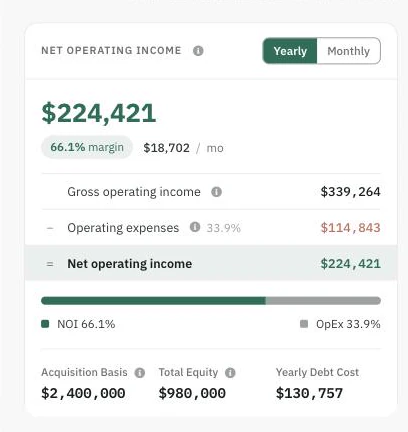
Enter income, expenses and financing, then review NOI, acquisition basis, equity and debt cost together. Detailed growth-and-exit projections and document import require Gold or Diamond.
Multifamily underwriting is the process of turning an apartment property’s actual income and expenses into a forward-looking model of cash flow, debt service and exit value, so you can decide what the property is worth to you. In DealWorthIt that means importing a T12 and rent roll, reconciling them against the unit mix, applying vacancy, loss-to-lease and operating expenses, layering financing, and projecting the hold to an exit — rather than rebuilding a spreadsheet for every deal.
What you put in, and what comes out
Every figure below is an input on the multifamily workflow or a metric it computes. Assumptions stay visible and editable — including the ones read from an imported document.
Key inputs
- Purchase price and the offer you are testing
- Unit mix and rent roll — in-place rents, occupancy, loss to lease
- T12 operating statement, mapped line by line into the model
- Other income: RUBS, parking, laundry, fees
- Operating expenses, including a replacement-reserve treatment you choose
- Debt: loan-to-value, interest rate, amortization, interest-only period
- Growth, inflation and exit-cap assumptions across the hold
Analysis outputs
- NOI and pro forma cash flow, year by year across the hold
- Cap rate on your price and on the price the debt supports
- DSCR and debt yield
- Cash-on-cash return
- IRR and equity multiple
- Suggested offer price
- Sensitivity grid — returns across rate and exit-cap movement
- A deal report and PDF on every plan; saved, customizable investor reports on Gold and Diamond
What the multifamily workflow does
T12 and rent roll import
Upload the operating statement and rent roll and DealWorthIt maps the rows into model line items — gross potential rent, vacancy, other income, controllable and non-controllable expenses — flagging the ones that need a human decision rather than silently bucketing them. Nothing is locked: every mapped figure stays editable, because an imported number you cannot argue with is worse than one you typed. Document import is a Gold and Diamond feature.
Pro forma projections across the hold
Project rent and expense growth, inflation, lease-up ramp, reserves, exit NOI basis and exit cap over the hold period, and see the cash flow and the equity position in each year. Pro forma projections are a Gold and Diamond feature.
Value-Add Improvements
Model what a renovation, a rent bump, a fee rollout or an expense reduction does to NOI, and therefore to value at exit — as an explicit scenario you can defend, not an optimistic input buried in the base case.
Syndication waterfall and investor splits
On Gold and Diamond, model preferred returns and one residual LP/GP split alongside the property underwrite. Multi-tier IRR hurdles and GP catch-up are not supported.
Scenario comparison
Save alternative versions of the same deal — a different price, rate, rent assumption or exit — and put them side by side. Silver includes 3 scenarios per deal, Gold 10, Diamond unlimited; side-by-side comparison is a Gold and Diamond feature.
The document side of this workflow — importing, reviewing and reconciling the T12 and rent roll — in full: T12 & rent roll analysis. Modeling LP/GP economics on the same underwrite: real estate syndication software
The analysis is one stage of five
DealWorthIt is a real estate investment intelligence platform, not a standalone calculator. The multifamily model sits inside the same workflow that found the property and will present the result.
Find
Discover on-market and off-market opportunities.
Research
Review ownership, debt, tax, property, comparable, and market data.
Analyze
Underwrite deals using asset-specific financial models.
Compare
Test scenarios and assumptions side-by-side.
Present
Create clear reports for investment decisions, partners, and teams.
Other investment types: Self-Storage · Single Family · New Construction
Multifamily analysis, answered
You underwrite a multifamily property by rebuilding its income and expenses from evidence, then projecting them forward. Start from the rent roll for in-place income and the T12 for actual operating expenses; adjust for vacancy, loss to lease and any expense the buyer will incur that the seller did not; that gives you NOI. Apply your financing to get debt service, cash flow and DSCR, then project growth and an exit cap across the hold to get IRR and equity multiple. The offer follows from the number the debt and your return target support — not from the asking price.
A T12 — trailing twelve months — is the property’s actual income and expenses for the last twelve months, month by month. It is the closest thing to evidence a seller provides, which is why it is the starting point for underwriting rather than the pro forma the broker attaches beside it. Reading it means checking whether expenses are complete, whether income is one-off or recurring, and whether the twelve months shown are representative.
Requirements vary by lender, loan program and market, so DealWorthIt does not publish a threshold as fact. What the model does is compute DSCR from your own inputs, so you can test 1.20×, 1.25× or a lender’s stated minimum against the same deal — change the price, the rate or the leverage and watch what each does to coverage and to cash flow before a lender runs the same numbers.
Yes. Import is a shortcut, not a prerequisite. You can enter the unit mix and rents directly and build the expense side from your own assumptions — which is the normal case for an off-market property where no operating statement exists yet.
Run your next multifamily deal through it
Find the property, research it, analyze it with the model built for it, compare the scenarios that matter, and hand your partners a report they can read.