
New construction pro forma software for ground-up development
A development deal is a budget and a schedule before it is an operating property. Model land, hard and soft costs, contingency and construction financing, then test the exit — for residential, retail, office, mixed-use or industrial.
Free account creation. A paid plan is required to analyze your own deals.
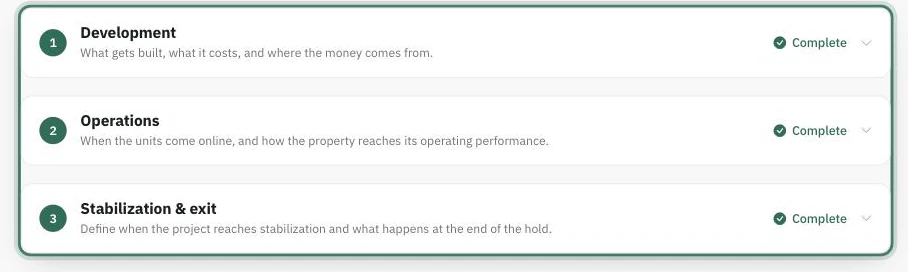
Build the development case in three stages
Work through development costs and funding, operations and lease-up, then stabilization and exit. All paid plans include construction underwriting; the detailed monthly schedule and area market context require Gold or Diamond.
A new construction pro forma is a projection of what a ground-up project costs to build, what it costs to carry while it is being built, and what it is worth once it is finished and stabilized. It is a development model rather than an operating one: the inputs are a budget and a schedule, the financing is drawn over time rather than funded at close, and the decisive output is the spread between total cost and completed value.
What you put in, and what comes out
Every figure below is an input on the new construction workflow or a metric it computes. Assumptions stay visible and editable — including the ones read from an imported document.
Key inputs
- Building type — residential single-family or multi-family, retail, office, mixed use, industrial
- Land and acquisition cost
- Buildable square feet
- Cost lines with fixed, per-unit, per-square-foot or percent-of-costs amounts
- Soft costs — design, permits, fees, financing costs, carry
- Contingency entered as a cost line with an explicit amount or calculation basis
- Construction loan commitment, monthly rates, maturity and funding order
- Build duration and completion date
- No exit, or sale at stabilization using forward-12 NOI, exit cap and selling costs
Analysis outputs
- Total development cost, broken into land, hard, soft and contingency
- Monthly interest on the opening drawn loan balance
- Equity required, and loan-to-cost
- Completed value and development profit
- Yield on cost, development spread, and project-level IRR and equity multiple when a funded exit is available
- Development profit re-run under a hard-cost overrun or an exit-value miss
- A deal report and PDF on every plan; month-by-month development schedules with advanced analysis on Gold and Diamond
What the new construction workflow does
A development budget, not a rent model
Land, hard costs, soft costs and contingency are separate inputs with separate treatment, and the model shows where the budget actually goes. Applying an operating pro forma to a project with no operations is the most common way a development deal gets underwritten wrong.
Construction financing on a draw schedule
A construction loan does not fund at close and does not accrue on the full balance from day one. The construction model accrues interest monthly on the opening drawn balance. Choose equity-first or pro-rata funding, and specify whether interest is capitalized, paid from equity or funded by the loan.
Multiple building types in one workflow
Residential single-family, residential multi-family, retail, office, mixed use and industrial are all building types within the same development workflow, each with its own buildable-area and cost profile — which is how commercial building types reach this platform. There is no separate commercial underwriting flow.
Overruns, priced before they happen
Hard-cost overruns and exit-value misses are correlated, and together they are what turns a profitable project into a break-even one. Contingency is a first-class input rather than a mental buffer, and every cost and exit assumption stays editable — so the bad case is a re-run you price before you commit, not a surprise you explain after.
The analysis is one stage of five
DealWorthIt is a real estate investment intelligence platform, not a standalone calculator. The new construction model sits inside the same workflow that found the property and will present the result.
Find
Discover on-market and off-market opportunities.
Research
Review ownership, debt, tax, property, comparable, and market data.
Analyze
Underwrite deals using asset-specific financial models.
Compare
Test scenarios and assumptions side-by-side.
Present
Create clear reports for investment decisions, partners, and teams.
Other investment types: Multifamily · Self-Storage · Single Family
New Construction analysis, answered
Choose no exit or sale at stabilization. Refinance-and-hold, permanent-loan sizing and construction LP/GP waterfalls are not modeled. A funded sale uses forward-12 NOI at stabilization divided by the exit cap, less selling costs and debt payoff. No-exit analyses do not show IRR or equity multiple.
The construction model uses a fixed rate or a monthly rate schedule you enter. It does not automatically model an index, spread, floor or cap, and it has no unused-commitment fee or construction-loan amortization. An interest reserve is part of the loan commitment, not extra capital. The workspace flags unfunded costs and outstanding debt at maturity.
You build a new construction pro forma by totalling what the project costs and comparing it to what the finished asset is worth. Add land, hard costs (buildable square feet times cost per square foot), soft costs and a contingency to get total development cost; add the interest carried on the construction loan across the build, based on the balance actually drawn rather than the full commitment. Then estimate completed value — either value per square foot, or stabilized NOI divided by an exit cap. The difference is development profit, and profit over total cost is your return on cost.
Yield on cost is stabilized NOI divided by total development cost — what the finished project earns against what it took to create. It is the development equivalent of a cap rate, and it is compared against the market cap rate the finished asset would trade at. That gap is the development spread; if it is thin, you are taking construction risk for a return you could have bought without it.
Loan-to-cost is the construction loan amount divided by total project cost, and it is the development analogue of loan-to-value. It matters because it sets how much equity the project needs and, together with the draw schedule, how much interest accrues before there is any income to pay it.
Contingency belongs in the model because it gets spent. A contingency held as a mental buffer is quietly consumed by the first change order and never shows up in the return; a contingency entered as a line item is priced into total development cost from the start, so every return the model reports is already net of it. And because the budget stays editable, testing what happens when it is not enough is a re-run, not a rebuild.
Run your next new construction deal through it
Find the property, research it, analyze it with the model built for it, compare the scenarios that matter, and hand your partners a report they can read.