
Construction Financing: LTC, Draws & Interest Reserve
Part of the Real Estate Development guide.
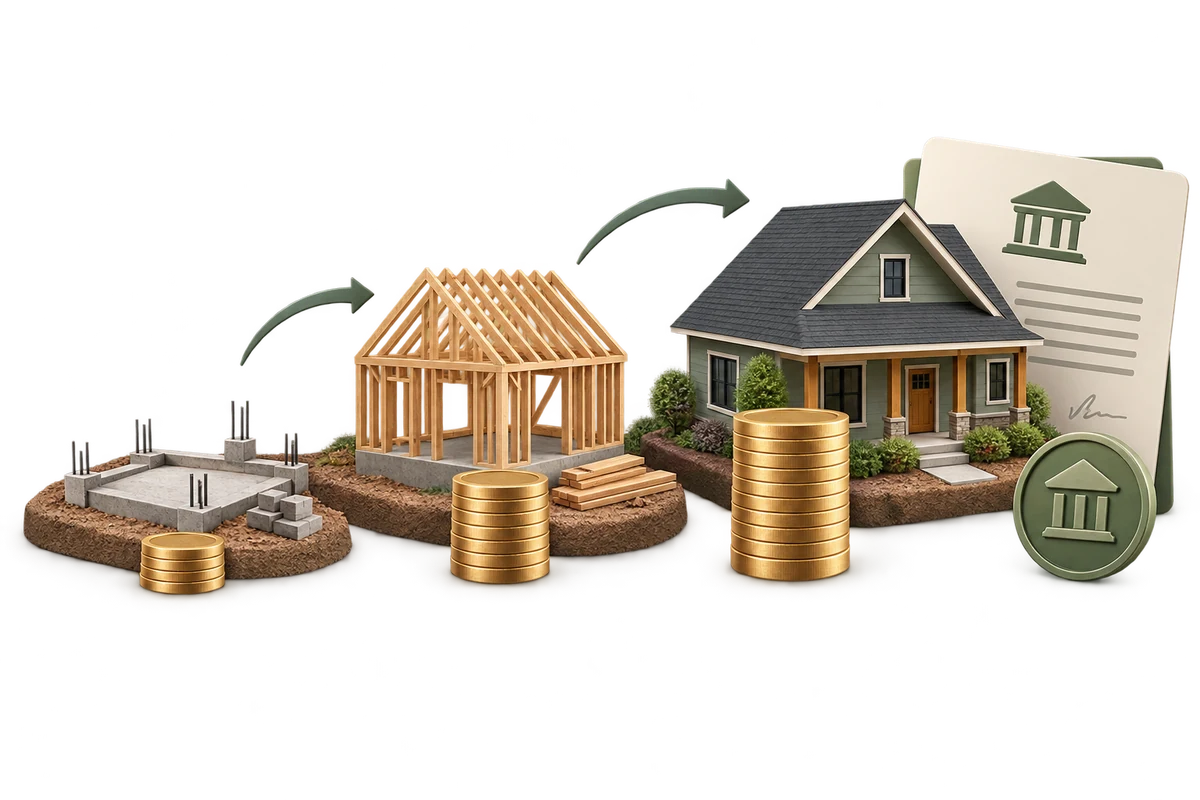
A construction loan does not hand you the full loan amount on day one. It funds a development in stages: the loan is sized as a share of project cost (loan-to-cost, or LTC), the money is released in draws as work is completed and verified, interest accrues on what has actually been drawn rather than on the full commitment, and an interest reserve — a budgeted pot of capital — pays that interest during the months when the project has no income of its own.
Those four mechanics — LTC, draws, drawn-balance interest and the reserve — are the whole difference between modeling construction debt correctly and modeling it like a mortgage. One caveat belongs up front: the exact draw procedures, eligible costs, interest treatment, reserve structure and equity-funding requirements depend on the lender and the loan documents. This guide explains how the machinery generally works; your loan agreement says how yours actually does.
Modeling a development deal? DealWorthIt’s new construction workflow sizes the loan by loan-to-cost and carries interest on an average drawn balance across the build — with every assumption editable.
Model Construction Financing →What Is Construction Financing?
Construction financing is debt that funds the creation of a building rather than the purchase of one. It differs from permanent debt in almost every mechanical respect: the term is short-to-intermediate (the build plus lease-up, not a long amortization), the loan funds project costs in stages as construction progresses, and the collateral is a project becoming a property rather than a property with operating history.
The loan is also designed to end. At completion and stabilization it is generally repaid — by a sale, by a refinance into permanent debt, or, where the loan was structured that way, by converting to a permanent facility. None of that is automatic: construction-to-permanent conversion is a specific loan feature, not a default, and a project that reaches completion without a clear repayment path has a financing problem no certificate of occupancy fixes. Bank supervisors treat this whole category — acquisition, development and construction lending — as its own risk discipline; the OCC’s Comptroller’s Handbook on commercial real estate lending covers it separately from income-property lending for exactly the reasons this article walks through.
What Is Loan-to-Cost (LTC)?
Loan-to-cost is the sizing ratio for construction debt:
LTC = Loan Amount ÷ Eligible Project Cost
It measures how much of the project’s cost the lender is funding — and, by subtraction, how much equity the borrower must bring, because whatever the loan does not cover, the equity must. A $13,000,000 loan against $20,000,000 of eligible project cost is a 65% LTC, which means $7,000,000 of borrower equity.
Lenders size against cost because, during construction, cost is the number that exists: there is no stabilized income yet, and the finished value is a projection. The word “eligible” carries weight — the cost basis the lender recognizes may differ from your internal total-development-cost figure, because some line items may be capped or excluded from the lender’s budget (developer fees are a common example, as covered in where each cost belongs). Model against your full cost; size the loan against the lender’s budget.
LTC vs LTV
The two ratios answer different questions about the same loan:
| Metric | Basis | Typical use |
|---|---|---|
| LTC | Project cost — what it takes to create the asset | Development and construction financing |
| LTV | Property value — what the asset is worth | Acquisition and permanent financing |
They can sit far apart on the same project: a development costing $20,000,000 that will be worth more once finished has a lower loan-to-completed-value than its loan-to-cost. In practice many construction lenders look at both — cost during the build, projected stabilized or appraised value for the exit — and neither ratio is the whole risk picture, which also includes the sponsor, the market, the schedule and the repayment path. Treat LTC and LTV as two constraints, not one interchangeable number.
How Construction Draws Work
A draw is a disbursement of the loan against work that has actually happened. The general cycle:
- The project incurs approved costs — a month of construction, an invoiced milestone.
- The developer submits a draw request documenting those costs.
- The lender — usually through an inspector — verifies the work is in place and the documentation supports the amount.
- The approved amount is funded.
- The outstanding loan balance increases, and interest starts accruing on the new balance.
Documentation requirements vary materially by lender, but a draw package may include contractor payment applications, invoices, lien waivers from contractors and suppliers, inspection reports, an updated budget, and any change orders since the last draw. The mechanics feel bureaucratic and exist for a sound reason: the lender is funding collateral that does not fully exist yet, so every draw is a check that the money became building.
Equity-First vs Pari Passu Funding
Who funds first is a negotiated term, and two common structures bracket the range. Under an equity-first structure, the borrower contributes some or all of the required equity before the lender advances substantial loan proceeds — the lender’s money arrives after the borrower’s is committed, which is why this is a frequent arrangement. Under a pari passu (pro rata) structure, debt and equity fund eligible costs side by side in an agreed proportion throughout the project.
These are examples of structures, not a menu with a default — actual funding mechanics live in the loan documents. The modeling consequence is real either way: the funding sequence determines when the loan balance starts building, which determines when interest starts accruing and how large the reserve must be. A model that ignores the sequence gets the interest wrong even when every other number is right.
Why Draw Timing Matters
One million dollars drawn in the second month of a build accrues interest for the entire remaining construction period. The same million drawn in the eighteenth month accrues interest for a few months. Same dollar, same rate — very different cumulative cost.
That is why construction interest cannot be read off the loan commitment. It is a function of the draw curve — how spending is distributed across the schedule — together with the rate and the construction duration. Projects that spend heavily early (land-adjacent site work, big material buys) carry more interest than projects with the same budget whose spending arrives late. This is also why the development pro forma treats the timeline as a first-class input: the schedule is not context for the budget, it is arithmetic inside it.
How Construction-Loan Interest Is Calculated
The core mechanic is simple: interest accrues on what is outstanding, not on what is committed.
Interest for a period ≈ Outstanding Drawn Balance × Periodic Interest Rate
In monthly form, a common approximation:
Monthly Interest ≈ Outstanding Drawn Balance × Annual Rate ÷ 12
The word “approximately” is doing honest work. Real loans specify day-count conventions (a 30-day month and an actual/360 year produce different numbers), most construction debt floats against a benchmark plus a spread so the rate itself moves, fees accrue on their own schedules, and where interest is capitalized into the balance it compounds. The loan documents define the actual calculation; the formulas above are for modeling, and they are close enough for a pro forma as long as you remember which one is the estimate.
Fixed vs Floating Construction-Loan Rates
A fixed-rate construction loan locks its rate for the term; a floating-rate loan is priced as a benchmark plus a spread and reprices as the benchmark moves. Much construction lending floats, and the most common benchmark for U.S. floating-rate commercial debt is SOFR — the Secured Overnight Financing Rate, a broad measure of the cost of borrowing cash overnight collateralized by Treasury securities, published daily by the Federal Reserve Bank of New York. A borrower’s actual rate is the benchmark plus a negotiated spread; the published number is never the whole rate.
The modeling consequence of floating: your interest cost is uncertain in exactly the period when you cannot pay it from operations. A pro forma built on today’s benchmark should also be run at a higher one — which is a sensitivity exercise, covered below, not a forecast. For how benchmarks feed underwriting more broadly, see the role of SOFR and Treasury rates in real estate underwriting.
What Is an Interest Reserve?
An interest reserve is a budgeted source of funds designated to pay the construction loan’s interest during the build, while the project produces no income. It is a line in the project budget and a part of the capital stack — funded by the loan itself, by equity, or by a combination, depending on the structure the documents set.
Three clarifications keep it honest. It is not free interest — every reserve dollar is a project cost that the debt and equity have to supply, and when the reserve is loan-funded, each month’s interest is added to the balance and starts accruing interest of its own. Its size depends on projected draw timing, the rate and the construction duration, not on a standard percentage of anything. And its terms — how it funds, what happens when it runs low, whether it can be replenished — are lender-specific.
Funded interest vs cash-paid interest
Who actually pays each month’s interest varies by structure. It may be paid from a loan-funded reserve (often called funded or capitalized interest, where the documents permit it), paid by the borrower in cash from equity, or split — reserve first, borrower thereafter. Capitalization is a negotiated feature, not a given; where it is not permitted, construction interest is a recurring cash call on the sponsor, and the model should say so.
How to Estimate an Interest Reserve
The accurate way is to model the balance over time:
- Forecast the project’s spending month by month.
- Apply the funding sequence — which costs equity covers, and when the loan starts funding.
- Compute the resulting loan balance in each month.
- Apply the periodic rate to each month’s balance.
- Sum the interest across the construction period.
- Add a cushion only as a deliberate, visible line — not by silently inflating the inputs.
For a first-pass pro forma, a simpler approximation stands in for the month-by-month model: assume the loan is drawn evenly, so the average outstanding balance is a fraction — often modeled near half — of the full loan:
Estimated Interest ≈ Average Drawn Balance × Annual Rate × Time (years)
This is an approximation, not a lender’s method: a front-loaded draw curve makes it understate interest, a back-loaded one makes it overstate. It is honest early-stage modeling as long as it is labeled an estimate and replaced with the scheduled version as the budget firms up.
A Worked Construction-Financing Example
Hypothetical numbers throughout, chosen for arithmetic clarity — not typical values, not a market quote:
| Item | Hypothetical assumption |
|---|---|
| Eligible project cost (interest reserve included) | $20,000,000 |
| Construction loan commitment | $13,000,000 |
| Loan-to-cost | 65% |
| Required borrower equity | $7,000,000 (35%) |
| Annual interest rate | 9% |
| Construction period | 20 months |
| Average drawn balance (assumed ~50% of loan) | $6,500,000 |
| Estimated construction interest | $975,000 |
The walk-through:
- LTC: $13,000,000 ÷ $20,000,000 = 65%. Equity fills the rest: $20,000,000 − $13,000,000 = $7,000,000, or 35% of eligible cost.
- Average drawn balance: assuming a roughly even draw pace, about 50% of the $13,000,000 commitment is outstanding on average — $6,500,000.
- Estimated interest: $6,500,000 × 9% × (20 ÷ 12) = $975,000 across the build.
- Sanity check against the wrong method: interest on the full commitment from day one would be $13,000,000 × 9% × (20 ÷ 12) = $1,950,000 — double the estimate. The gap between those two numbers is the entire point of drawn-balance modeling.
A Draw-Timing Example
Here is the same loan as a simplified draw sequence — four draws instead of a real project’s many, because the shape is what matters:
| Period | New draw | Ending loan balance | Interest that month (9% ÷ 12 = 0.75%) |
|---|---|---|---|
| Month 1 | $1,000,000 | $1,000,000 | $7,500 |
| Month 4 | $3,000,000 | $4,000,000 | $30,000 |
| Month 8 | $5,000,000 | $9,000,000 | $67,500 |
| Month 12 | $4,000,000 | $13,000,000 | $97,500 |
The month-twelve interest is thirteen times the month-one interest, because the balance is thirteen times larger. A fully drawn $13,000,000 at 0.75% per month costs $97,500 every month until repayment — which is why the months after completion, when the loan is fully drawn and the building is leasing up, are often the most expensive months of the whole financing. A mortgage-style model that charges $97,500 from month one overstates early interest; a model that ignores the tail understates the total. The draw curve is the truth between them.
Interest-Reserve Sensitivity
Because the reserve estimate is a product of balance, rate and time, it moves when any of them do. Applying single hypothetical changes to the worked example’s $975,000 estimate:
| Hypothetical change | Estimated interest | Change vs. base |
|---|---|---|
| Base case | $975,000 | — |
| Rate 9% → 10% | $1,083,000 | +11% |
| Construction 20 → 26 months | $1,267,500 | +30% |
| Average drawn balance 50% → 60% of loan | $1,170,000 | +20% |
| Higher rate and longer schedule together | $1,408,000 | +44% |
None of these cases is extreme, and the last row is the instructive one: a one-point rate move plus a six-month slip — both ordinary project risks — adds more than forty percent to the interest cost. A reserve sized to the base case with no cushion is a reserve that a normal amount of bad luck exhausts.
Construction Loan Fees
Interest is not the only financing cost. Depending on the loan, fees may include an origination or commitment fee (often charged on the full commitment, not the drawn balance), an unused-commitment fee on the undrawn portion where the documents provide for one, extension fees if the loan runs past its initial maturity, the lender’s legal costs, and per-draw inspection or administration fees. Individually small, they are collectively a real budget line — and they belong in the financing costs of the pro forma, not in the rounding.
When Costs Overrun or Schedules Slip
When costs exceed the funded budget, the sequence generally runs: contingency absorbs the overrun first; change orders go through the approval process the documents require; the lender may rebalance the budget; and if the gap outlives the contingency, the borrower is usually the one who funds it — construction loans commonly require the project to remain “in balance,” meaning remaining funding covers remaining costs, with additional equity as the cure when it does not.
When the schedule slips, the costs compound quietly: more months of interest on a balance that is largest exactly when the delay happens, possible extension fees, more carrying costs, later stabilization, and a later exit or refinance. A long enough delay can exhaust the interest reserve itself — at which point interest becomes a cash call. This is why the pro forma’s stress cases should always include a slower schedule, and why testing assumptions in scenarios rather than one base case is the core discipline of multi-scenario analysis.
Common Construction-Financing Mistakes
- Calculating interest on the full loan commitment from day one — roughly double the drawn-balance estimate in the example above
- Confusing LTC with LTV, and sizing the equity check off the wrong denominator
- Assuming every internal project cost is lender-eligible — the lender’s budget defines the cost basis the loan sizes against
- Ignoring the funding sequence: equity-first and pari passu produce different balances, and different interest, from identical budgets
- Forgetting loan fees, or modeling the origination fee on the drawn balance when it is charged on the commitment
- Underestimating extension risk — the fee and the extra months of interest arrive together
- Treating the interest reserve as profit if unspent, instead of as contingency for the financing
- Modeling a floating-rate loan at a single frozen rate with no higher-rate case
- Failing to model delay at all, when delay is the single most common construction outcome
- Missing that an over-budget project usually means additional equity — the loan does not grow because the costs did
- Double-counting the interest reserve: once in soft costs and again as a financing line
Where Financing Sits in the Development Pro Forma
The financing pieces connect in a chain that runs through the whole model:
Total Development Cost → Equity + Construction Debt → Draw Timing → Interest Expense → Interest Reserve → Stabilization / Exit
Total development cost — built from land, hard costs, soft costs and contingency — sets the funding need. LTC splits it between debt and equity. The draw timing turns the debt into a balance; the balance and the rate produce the interest; the interest sizes the reserve, which is itself part of the cost the loan and equity fund. And all of it terminates at stabilization, where the construction loan is repaid, refinanced or converted. This article is the financing chapter of the full pro forma walkthrough — the model only closes when every link in that chain is an explicit assumption. And because financing costs sit inside the cost basis, they flow straight into the project’s yield on cost.
How DealWorthIt Handles Construction Financing Assumptions
DealWorthIt’s new construction workflow carries the financing assumptions this article covers as explicit inputs: the construction loan sized by loan-to-cost, an interest rate, and the build duration. Interest is carried on an average drawn balance across the construction period — the first-pass estimation method described above, stated as what it is, rather than a month-by-month draw schedule. The model returns total development cost with the interest carry, the equity required and loan-to-cost, completed value, development profit and return on cost — and every assumption stays editable, so the higher-rate and longer-schedule cases from the sensitivity table are re-runs, not rebuilt spreadsheets. Alongside the model, the platform provides live SOFR and Treasury benchmark data for research context.
Analyze a new construction deal — or start from the concepts in the real estate development guide.
Final Takeaway
Construction financing is a machine with four moving parts: LTC sets how the cost splits between debt and equity, draws turn the commitment into a balance as work completes, interest accrues on that balance rather than the commitment, and the reserve is the budgeted capital that pays it until the building can. Model the balance over time — or use the average-balance estimate and call it one — stress the rate and the schedule, and read the loan documents for the mechanics, because that is where the general rules in this article become your project’s actual terms.
Ready to analyze your next deal?
Find, research, analyze, compare, and present real estate deals with DealWorthIt.
Related workflow in DealWorthIt: New Construction
← Back to all articles